Don't Forget the Fifth: Why Your Spare Tyre Is the Most Neglected Piece of Kit in Your Car

There's a piece of kit sitting in your boot right now that you probably haven't looked at in months — possibly years. It lives under a panel, beneath a mat, or strapped to the back of your vehicle, quietly being ignored while you focus on everything else. Your spare tyre. And for most drivers, it only gets attention when something goes horribly wrong.
The problem is that by the time you actually need it, the moment is already stressful enough. You're on the side of the A1 in November drizzle, lorries thundering past, and you're about to discover that your spare is flat, your jack is buried under three bags of camping gear, and you can't remember the last time you checked whether the wheel brace actually fits your locking nuts. Sound familiar? Let's fix that before it happens.
What You've Actually Got Back There
First things first — do you even know what type of spare you're carrying? Because not all spares are created equal, and the difference matters a lot.
Full-size spare: The gold standard. A matching wheel and tyre that lets you drive normally after a swap. Less common on newer cars because of space and weight.
Space-saver (or 'donut'): The skinny yellow-rimmed wheel that lives in most modern boots. It works, but it comes with restrictions — typically a 50mph speed limit and a maximum distance of around 50 miles. It is not a long-term solution.
Run-flat tyres: Some cars don't carry a spare at all and rely on run-flats, which allow you to drive slowly to a garage after a puncture. Good in theory, but you'll still want to know what you're working with.
Check your handbook if you're not sure. Knowing what you've got is the foundation of everything else.
The Pressure Problem Nobody Talks About
Here's the thing about spare tyres: they lose pressure over time even when they're not being used. A spare that's been sitting untouched for 18 months could easily be down to 20 PSI or less — completely useless in an emergency.
Most manufacturers recommend checking your spare's pressure every month alongside your regular tyres. Almost nobody does this. The recommended pressure for a spare is usually printed on a sticker inside the boot or in your handbook — it's often higher than your main tyres, particularly for space-savers.
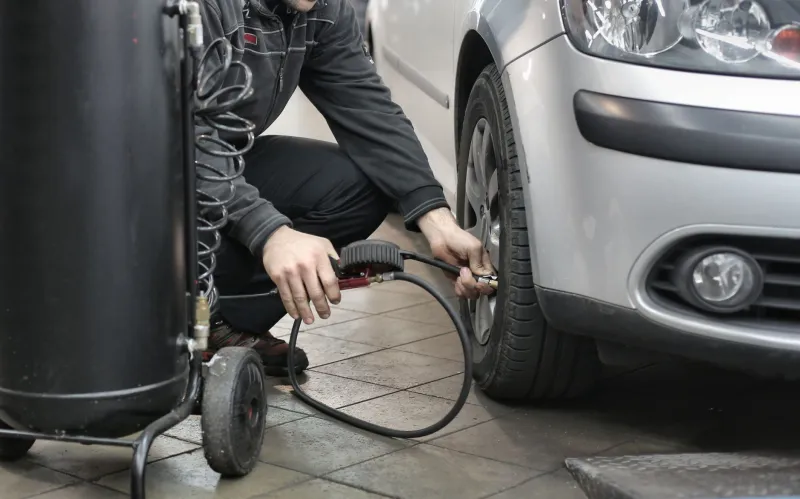
A decent portable tyre inflator is genuinely one of the best bits of kit you can keep in your car. Compact 12V units that plug into your car's power socket are widely available and can top up a spare, inflate a slightly soft main tyre, or rescue a slow puncture in minutes. Look for models with a built-in pressure gauge and auto shut-off — they make the job much less faff.
Repair Kits: A Useful Backup, Not a Replacement
Portable tyre repair kits — the kind that come with a sealant canister and a small compressor — are worth carrying alongside (not instead of) your spare. They're ideal for slow punctures caused by a nail or small screw, and they can get you moving quickly without having to change the wheel at the roadside.
Bear in mind that sealant is a temporary fix. It gums up the inside of your tyre, and many tyre fitters will charge extra to clean it out. Always tell them you've used sealant, and get the tyre properly inspected as soon as you can.
For more serious damage — a blowout, a sidewall tear — sealant won't cut it. That's when you need the actual spare.
Checking the Tyre Itself
Pressure isn't the only thing to check. Give the spare tyre a proper look every few months:
- Tread depth: Even if it's never been used, rubber degrades. Most experts recommend replacing a spare that's more than six years old regardless of mileage.
- Cracking or crazing: Check the sidewalls for fine cracks, which indicate the rubber is drying out and losing integrity.
- Wheel condition: Check for corrosion around the rim, especially if the spare lives under the boot floor where moisture can gather.
A tyre that looks fine from the outside might still be compromised. If in doubt, get it checked at your next service.
Sorting Out the Boot So You Can Actually Use It
None of this matters if your spare is buried under a mountain of gear when you need it. Boot organisation around your spare setup is genuinely important — and often an afterthought.
Here's what you want to be able to access quickly:
- The spare itself — obvious, but make sure it's properly secured in its housing and not rattling around
- Jack and wheel brace — know where they live and make sure the brace fits your wheel nuts (including any locking nuts — keep the adapter with the kit, not in the glovebox)
- Gloves — changing a tyre is a filthy job; a pair of nitrile or work gloves tucked with your kit makes a real difference
- A torch — because punctures don't only happen in daylight
- Warning triangle or LED road flare — legally required in many European countries and just sensible on UK roads
- Hi-vis vest — keep one in the boot, not the cabin, so you can put it on before you get out of the car
Boot organisers and collapsible storage boxes are brilliant for keeping all of this together in one place. Label a bag or box as your 'tyre kit' and make sure everyone in the household knows where it is.
The Locking Wheel Nut Issue
This is the one that catches people out more than almost anything else. If your wheels have locking nuts — and most alloy wheels do — you need the adapter key to remove them. Without it, a breakdown technician cannot change your tyre either.
Keep the adapter in your tyre kit, not floating around in the glovebox or a coat pocket. If you've lost it, contact your dealer — they can often source a replacement using your car's VIN.
One Last Thing
If your car doesn't have a spare at all — increasingly common as manufacturers prioritise boot space — it's worth looking into whether a spare wheel can be retrofitted for your model. For regular long-distance drivers, those heading into remote parts of Scotland or Wales, or anyone who does a lot of rural driving, having a proper spare rather than relying on a repair kit and roadside assistance can be genuinely reassuring.
Your spare tyre is the one piece of kit you hope you'll never use. But when you do need it, you really need it. A bit of regular attention now is worth infinitely more than a cold, stressful wait on the hard shoulder.